tawasuyu · Perceive
hayma: a JavaScript engine written from scratch in one month — it passes 99.7 % of Test262 and already runs Octane in less time than QuickJS
There are three JavaScript engines in the world that matter, and all three belong to three companies: Google's V8, Mozilla's SpiderMonkey and Apple's JavaScriptCore. Every browser runs on one of them. Someone wrote a fourth one, from scratch and in Rust, for tawasuyu's browser. It is called hayma, it was born on October 15, and one month later it passes 99.7 % of JavaScript's official suite —51,971 tests, 9,678 more than QuickJS— and runs Octane in less time than native QuickJS.
24 min readBy Gioser Editorial
Every web page you open carries a program inside it, written in JavaScript, and something has to run it: the JavaScript engine. There are three engines in the world that matter —Google's V8, Mozilla's SpiderMonkey and Apple's JavaScriptCore— and every browser you use runs on one of them. This article tells how someone wrote a fourth one, from scratch and in Rust, for tawasuyu's browser: hayma. It was born on October 15, 2026. One month later it passes 51,971 of the 52,133 tests of JavaScript's official suite —99.7 %, 9,678 more than QuickJS, the engine it is meant to replace—, has the whole new date API, Temporal, runs all seven programs of Google's Octane benchmark in 66 % of the time QuickJS compiled for the machine takes, loads react.dev, google.com and github.com without a single error, and a build of it boots inside a home-grown operating system. With the numbers in plain sight, including the ones that still fall short.
The name
In Quechua, hayma names community collaboration: work done among many so that something comes out that nobody would lift alone. It is a tribute to that way of working, not a flag: the project does not speak for any people, it learns from them. And it suits an engine that was written exactly that way, as told below: between one person and several AI agents, with a judge that believes no one.
Why write another JavaScript engine
tawasuyu has its own browser, puriy, with its own page engine: no Chromium or WebKit underneath. Until now it ran JavaScript with QuickJS, a small and excellent engine written in C, locked inside a WebAssembly virtual machine so a page could not escape. It works. But it has a ceiling that patches don't fix, and the ceiling is in the core:
- It counts references on every copy of every value, across 55,000 lines of C that take it for granted. A modern garbage collector —the kind that moves objects to compact memory— does not fit there.
- It does not speculate. Fast engines guess which types a program will see and compile for that; when they guess wrong, they back out. QuickJS has nowhere to hang that.
- The DOM lives somewhere else. In puriy, measured on real pages, between 72 and 92 % of JavaScript time went into crossing the border between the engine and the page tree.
So on October 15 the question stopped being how to improve QuickJS and became another one: if the core has to be rewritten anyway, let it be born built for this. An engine of its own, in Rust, compiling to machine code, with one rule that is not reopened: the semantics are not invented. The parser and every library function follow the ECMA-262 specification step by step; originality goes into the core, never into the language.
First the judges, then the engine
The first thing written was not the engine. It was the instruments to know whether the engine was right, and they were run against QuickJS before hayma existed, so that the starting number was measured and not assumed:
- Test262, the official suite of the committee that defines JavaScript: more than 52,000 programs, each designed to break an engine at a precise point of the specification.
- web-platform-tests (WPT), the suite browsers use to measure each other on the DOM and the web APIs.
- A corpus of heavy pages —youtube, figma, discord, Gmail, Maps, notion…— with a condition written per site to say whether the application became usable, not just whether it loaded.
- A speed benchmark with Octane (Google's classic benchmark), parsing four real bundles of up to 5 MB, and minimal tests of calls and properties, with node as the ceiling.
And one rule for all of them: QuickJS is the oracle. If hayma does something different from QuickJS on the same input, it is a hayma bug until proven otherwise. Every judge also carries its control arm: programs written to fail on purpose along each path, which must come out wrong. A judge that approves everything is not measuring anything.
One month, counted by the same judge
The first commit is from the afternoon of October 15, 2026. Since then:
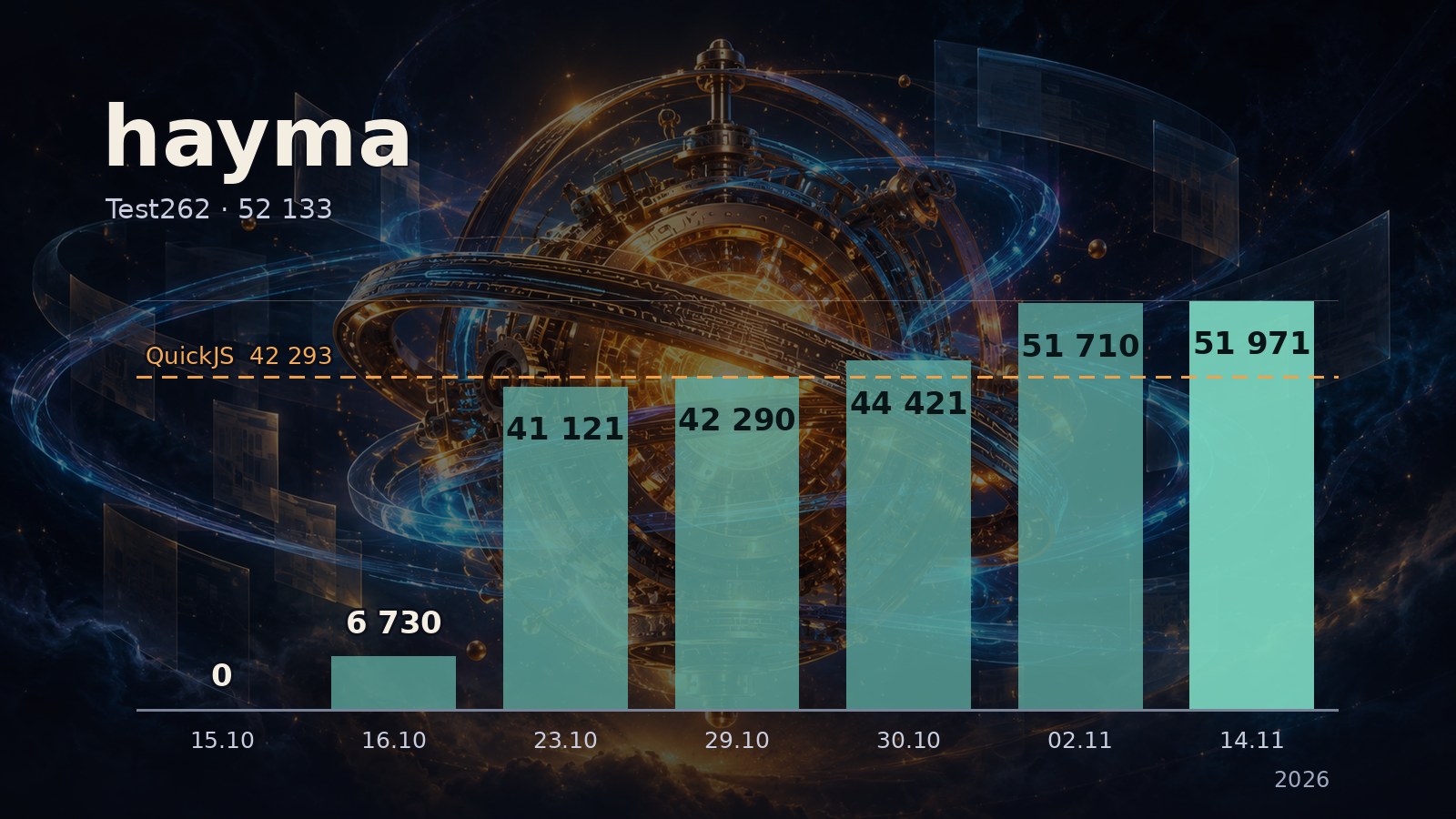
- October 16: the first full Test262 run with hayma gives 13.1 %. No standard library yet, only the language: 26.5 % of the language tests. That is the number published on this blog in the article about tawasuyu, and it was true that day.
- October 23: 79.6 % (41,121 of 51,664), against QuickJS's 81.0 %. In one week: classes, generators, async, modules,
Proxy,BigInt,Promise,Date, typed arrays, regular expressions. - October 29, measured for this article: 42,290 of 52,133. QuickJS, with the same harness: 42,293. Three tests short.
- October 30, before dawn, with three more tasks closed —what was left of the language, restricted
callerandargumentson functions, andimport()from an ordinary script—: 42,506. QuickJS, 42,293. hayma passes 213 more tests. - October 30, at night, after a day with two agents working in parallel —Annex B, immutable buffers,
Array.fromAsync,DisposableStack, nearly all of internationalization,ShadowRealmandAtomics—: 44,421. 2,128 more tests than QuickJS. - October 30, close to midnight:
Temporal, JavaScript's new date API, complete: 4,605 of 4,605 tests inbuilt-ins/Temporal. With a caveat that matters and comes back below: the arithmetic of calendars, time zones and durations was not written by hayma, it comes from temporal_rs 0.2.6, the Rust library that Boa and V8 use. What hayma writes is the JavaScript layer on top. The total went from 44,421 to 50,968 without losing a test. - October 31, before dawn:
Intl.DateTimeFormatdrops its fixed pattern and formats with CLDR's patterns, through ICU4X, with the system's tzdata time zones. Checked against node 26 on 456 cases —thirteen languages, four zones, styles and single fields—, 415 come out identical, character by character: US English 57 of 57, Spanish 56 of 57, Quechua 56 of 57. That same night: top-levelletandconstmove out of the global object, as the specification says; the proposals Test262 already measures (Iterator.prototype.chunks,windowsandincludes,Promise.allKeyed,Error.prototype.stack, the oldRegExp.$1), and almost all the small things QuickJS passed and hayma did not. - November 2:
import deferandimport source, the two new module phases —a module loaded now and run only when someone touches what it exports—, and the small things left in languages: German compact numbers and the ten-thousands of Japanese, Chinese and Korean, Indian digit grouping, «US$» in Korean and Chinese, relative times in Polish. - November 2, the run for this article, on
mainat commit2e7e99344: 51,710 of 52,133, 99.2 %. 9,417 more tests than QuickJS. - November 14, after two weeks spent on speed rather than on the library: 51,971 of 52,133, 99.7 %, on
mainat commita3d140683. 9,678 more tests than QuickJS. The table below is the November 2 one; what changed since then is 261 more tests passed, spread over several areas.
The full table, with the same suite (Test262 at commit d53ebc8b1, all of test/ except staging/, 52,133 tests) and the same harness for both engines:
| area | tests | hayma | QuickJS |
|---|---|---|---|
| everything | 52,133 | 51,710 (99.2 %) | 42,293 (81.1 %) |
without intl402/ or Temporal | 44,146 | 43,766 (99.1 %) | 42,270 (95.8 %) |
language/, the language | 23,726 | 23,608 (99.5 %) | 23,314 (98.3 %) |
built-ins/ without Temporal, the library | 19,218 | 19,002 (98.9 %) | 17,831 (92.8 %) |
annexB/, the old web | 1,086 | 1,042 (95.9 %) | 1,013 (93.3 %) |
intl402/ without Temporal, languages | 1,353 | 1,312 (97.0 %) | 23 (1.7 %) |
ShadowRealm | 64 | 59 (92.2 %) | 0 (0.0 %) |
Atomics | 389 | 350 (90.0 %) | 0 (0.0 %) |
| Temporal (in both directories) | 6,634 | 6,632 (99.9 %) | 0 (0.0 %) |
Percentages over all the tests in the area, the same number for both engines; in bold, whichever passes more. hayma ran on main at commit 2e7e99344, on November 2, with 2 threads, in 10,036 s —almost three hours, on a machine shared with other builds—; the binary of that run is, byte for byte, the one built from that commit. QuickJS ran on October 15, with 4 threads, in 1,211 s: it is QuickJS-ng 0.15, the one puriy runs, and it ships neither Temporal nor ShadowRealm nor Atomics. Against the October 30 run, the one behind the previous version of this article, hayma passes 7,292 more tests and loses three, all three from Atomics.waitAsync waiting on other threads, which time out when the machine is loaded.
How to read it: hayma is ahead in every area. In the language, by 294 (23,608 against 23,314); in the library, by 1,171 (19,002 against 17,831); in Annex B, compatibility with the old web, by 29 (1,042 against 1,013). And there are four rows where QuickJS is at zero:
- Temporal, 6,632 of 6,634 (4,605 of 4,605 in
built-ins/, 2,027 of 2,029 inintl402/): the API meant to replaceDate, with dates without times, times without dates, durations, instants and zoned date-times, in any calendar. Here is the most important caveat of the article: the arithmetic is not hayma's. Adding a month to January 31, going from the Gregorian calendar to the Hebrew one, or knowing what time it is in Tokyo when Madrid changes its clocks is worked out by temporal_rs 0.2.6, a Rust library born in Boa —another JavaScript engine in Rust— that V8 also uses. What hayma wrote is everything that turns it into JavaScript: the eight types with their constructors and methods, the options read in the exact order the specification demands —some tests measure only that—, the conversions from strings and objects, every error, and Temporal's way throughIntl.DateTimeFormatandtoLocaleString. It is the same deal as with languages, which lean on ICU4X: without that layer the 6,634 tests do not pass, and without temporal_rs hayma would not have Temporal today. - Languages (
intl402/): 1,312 against 23. Number, date, relative-time and duration formats, lists, plurals, alphabetical order per language, word and sentence breaks, names of languages and regions, and the usual methods —toLocaleString,localeCompare,toLocaleUpperCasein Turkish or Lithuanian— going through them. On top of ICU4X, compiled in, and since October 31 with dates in CLDR's patterns. ShadowRealm, 59 of 64: a separate JavaScript realm, with its own built-in objects, that runs code without being able to touch the outer one's. In hayma it is another machine on the same heap.Atomics, 350 of 389: memory shared between threads, withwaitandnotifythat really put agents to sleep and wake them, andwaitAsync.
And the count the other way around shrank to almost nothing: there are 9,422 tests hayma passes and QuickJS does not —6,632 from Temporal, 1,289 from languages, 350 from Atomics, 195 from regular expressions, 204 from typed arrays, 299 from the language— and 5 the other way around, which are in «What is not there yet».
What is inside
Writing an engine that passes tests is one thing; writing it so that one day it runs like V8 is another. The deep decisions, each with what was measured:
- The heap cage. All JavaScript memory lives in a reserved region, and pointers between objects are 32-bit offsets from its base: a memory bug in the compiler writes inside the cage and cannot reach the rest of the process. V8 added this years after it was born («V8 sandbox») and had to retrofit it piece by piece; here it is there from day one. The test: a million random pointers and fields land inside, in every cage; the control arm, without the mask, gets a segmentation fault.
- 8-byte values with NaN-boxing, shared shapes (V8's «hidden classes») with transitions, and inline caches from the interpreter on.
- A generational garbage collector that moves objects, with incremental marking: on Octane's Splay —the case built to torture the collector— the longest pause was 0.554 ms, and throughput went up 21 % against collecting all at once. Today, in this article's benchmark, the longest pause in six of the seven Octane cases stayed between 0.4 and 5.3 ms.
- The heap can be saved to disk and revived. A test application —classes with inheritance, private fields, a generator halfway through,
asyncfunctions waiting, a pending timer— is dumped whole, revived in another cage, and answers the same 23 questions letter by letter. That is what will let a tab sleep and wake up with a half-written draft, instead of reloading the page as Chrome does. - It boots from an image. A JavaScript «realm» with all its built-in objects starts from a 79 KB image embedded in the binary in 0.83 ms, against 4.01 ms to build it each time. Measured on October 20, when the realm was small —1,084 objects—: with today's library it has to be measured again.
- Library functions are born from the specification. An extractor reads the official ECMA-262 text, pinned to a commit, and pulls out its 549 functions with their signatures and numbered steps; from that comes each function's skeleton, with the steps as comments, completed against Test262.
- Unicode and languages, compiled in, on ICU4X: checked against V8's ICU, 866 of 866
\p{…}properties, case mapping and normalization identical across all 1,114,112 code points, and 18,000 collation comparisons in Spanish, English and Quechua without a single difference. - Its own regular expression engine, checked against V8: the same captures on 38,467 of 38,467 pattern–text pairs, and on another 113,012 random ones. Along the way it found two V8 defects, documented.
- The core needs no operating system: the parser, the bytecode compiler, the interpreter and the library compile without Rust's standard library. That is what makes possible what comes further down.
Two compilers to machine code
An interpreter reads the program one instruction at a time. Fast engines also translate what repeats most into machine code. hayma has the two tiers a big engine has:
- T1, by templates (copy-and-patch, the technique CPython 3.13 premiered): each bytecode instruction has a machine-code template compiled when the program is built; at run time they are copied and their holes patched. It compiles almost for free.
- T2, optimizing, on Cranelift: it builds SSA form from the bytecode and from what the caches learned, speculates, and if an assumption fails it falls back to the interpreter in the middle of the function (deoptimization).
Measured in processor instructions —wall-clock time on the shared machine varied twofold between two identical runs—, against the interpreter: Octane's NavierStokes runs with 31 times fewer instructions and Richards with about 5 times fewer. In a minimal test, a loop without calls comes out 24 to 26 times faster with T1 than interpreted.
And what matters most in a compiler that speculates is not that it is fast but that it gives the same result. A random program generator ran each program in the interpreter, in T1 and in T2, and compared: 24 hours, 440,543 programs, zero differences. When deoptimization arrived a fourth mode was added —T2 giving up on purpose at every guard—: 162,460 more programs, zero differences. Compiled-code memory is W^X: it is either written or executed, never both.
Regular expressions have their own compiler to machine code, with the same Cranelift: checked against the regex interpreter over 49,024 runs, zero differences in captures and in steps.
Speed, against the real QuickJS
Until November 2 this article compared against QuickJS as it runs in puriy, compiled to WebAssembly. That yardstick favoured hayma, because a QuickJS in WebAssembly runs slower than one compiled for the machine. So the yardstick changed: native QuickJS, QuickJS-ng 0.15.0 built with -O3 for this same machine, measured the same way as hayma. Against that one, on November 2 hayma was 2.0 times slower on Octane: 27.0 s of CPU against 13.5.
The next two weeks went only to speed, in two lanes at once: one on the optimizing compiler (T2), the other on the interpreter and its caches. The final clean measurement is the one from November 16, on main at commit a3d140683: hayma with its real tiering —the interpreter starts, T2 compiles what repeats on another thread—, five rounds alternating with native QuickJS, with the machine's load under 4. The ratio is hayma's time ÷ QuickJS's time: below 1, hayma takes less.
| case | hayma, wall clock | QuickJS | ratio | ratio in CPU of the program thread | ratio in total CPU |
|---|---|---|---|---|---|
| Richards | 350 ms | 637 ms | 0.55 | 0.53 | 0.59 |
| DeltaBlue | 1,166 ms | 1,174 ms | 0.99 | 0.91 | 1.25 |
| NavierStokes | 596 ms | 1,766 ms | 0.34 | 0.37 | 0.38 |
| Splay | 298 ms | 257 ms | 1.16 | 1.02 | 1.12 |
| RayTrace | 630 ms | 797 ms | 0.79 | 0.80 | 0.83 |
| Crypto | 219 ms | 533 ms | 0.41 | 0.38 | 0.79 |
| RegExp | 3,440 ms | 4,711 ms | 0.73 | 0.75 | 0.72 |
| all seven | 6,673 ms | 10,128 ms | 0.66 | 0.69 | 0.76 |
What it says, without makeup:
- On the wall clock, hayma runs Octane's seven cases in 66 % of native QuickJS's time, and the program thread spends 69 % of the CPU. It wins five cases: NavierStokes and Crypto in less than half, Richards, RegExp and RayTrace.
- In total CPU too: 0.76, counting what T2 compiles on another core. On November 9 that figure was 1.05: whoever watched the clock won, whoever paid the electricity did not. Now both do.
- Splay is still behind —1.16 on the wall clock—, and DeltaBlue is tied on the clock (0.99) but spends 1.25 times QuickJS's CPU, because it is where the most compiling happens.
A week earlier, on November 9, the same measurement gave 0.81 on the wall clock and 1.05 in total CPU, with DeltaBlue 1.32 times slower. What went in between: T2 generates less intermediate code for each operation, and compiling costs less; == between two integers, two objects or two booleans no longer calls into Rust. In the interpreter, a property load that always misses stops trying to be cached. And the TypeScript type check, the largest program in the benchmark, went from 370 to 256 billion instructions with the interpreter, 31 % fewer, and with tiering from 178 to 140.
And there is one where hayma loses by a lot: uglify-js, which minifies code. In the same November 16 run, minifying takes hayma 2,154 ms and QuickJS 425 ms: five times slower on the clock, and 9.6 times in total CPU. Its work is spread over thousands of functions that each run a few times, and compiling them costs more than it saves: with synchronous tiering it is 9.1 billion instructions, with the interpreter alone 4.3. Since November 11 that figure with tiering dropped 32 %, but it is not enough.
And node, with all of V8's JIT, is in another league: Octane's seven cases took it 0.71 s on October 31.
The web: the DOM in the same heap
hayma's most valuable decision is the one that goes after that 72–92 %: a DOM node is an object in hayma's heap. The collector traces it like any other object, and reading el.textContent does not have to cross any border. Chrome pays for the same thing with two heaps, V8's and the DOM's, and cross-tracing between them.
- The DOM bindings are generated from the WebIDL files the web itself uses to describe its interfaces. The WebIDL reader was checked line by line against webidl2.js —the one used by the official project that publishes those files— over all 342 files: 0 different lines out of 21,985.
- Real pages. react.dev, google.com and github.com load on hayma and run their JavaScript with zero errors, just as with QuickJS. Over a corpus of 34 sites, 26 lay out exactly the same boxes on screen as with QuickJS; of the eight that differ, seven are hayma running something QuickJS never got to run.
- WPT. On October 16, with QuickJS, puriy passed 1,543 subtests across five areas of the web platform. Today, on the same 949 files, hayma's realm passes 61,798: the difference is not only of quality but of reach, because many files that died on their first line with QuickJS now run to the end and count all their cases. Some of them, area by area:
| WPT area | QuickJS, Oct 16 | hayma, Oct 30 |
|---|---|---|
url/ | 168 of 236 | 469 of 555 |
encoding/ (the area's root) | 111 of 1,306 | 11,194 of 11,321 |
dom/nodes | 758 of 3,036 | 7,727 of 9,144 |
dom/ranges | 6 of 305 | 40,198 of 40,478 |
dom/events | 161 of 451 | 442 of 714 |
all of html/ | not run | 79,593 of 90,175 (88.3 %) |
What goes the other way is counted too: 253 subtests that QuickJS passed and hayma does not, by name —105 of them in a single file, and some are the same test reported under a different name by each engine—. Same WPT commit (e58225abb), same files preprocessed by the same code for both judges, no WPT server: whatever needs a server comes out as «no host», not as a failure. Since last week html/ includes a real 2D canvas on tiny-skia, which draws and lets you read the pixels back.
All the way inside a home-grown operating system
Since the core needs no operating system, the whole interpreter —parser, compiler, machine and library— compiles to a WebAssembly module with not a single import. On October 19, run under wasmtime against Test262's language tests, it gave exactly the same results as the native build, with the same error message on every test: 23,726 compared, zero different (about 3.8 times slower). And that module is an application of wawa, tawasuyu's own operating system, which boots on the hardware with no Linux underneath.
That part broke that same October 19 and nobody saw it for eleven days. A change to use math functions from Rust's standard library pulled it in unconditionally in three crates, and with it the module stopped linking; the rest of the repository stayed green, because no check compiled hayma for WebAssembly. It turned up when someone tried to compile it again, eleven days later. On October 30 it came back (e62beb274): the math functions, on top of libm when there is no standard library, and a 35-second guard that compiles both modules and fails if either breaks. The module gives the same as the native build in Math, Number and Date —1,249 of 1,261 both—.
And it no longer fit inside wawa: the engine had grown from 860 KB to 2.36 MB, while an object in wawa's file system has a 1 MiB ceiling, and building its JavaScript realm cost 40.6 million units of fuel against the 20 an application gets to start. No trimming fit in 1 MiB —with the most aggressive WebAssembly optimizer it stays at 1.84 MB—, so the ceiling was left alone: wawa's boot stores the module split into 512 KiB chunks with an index in front, the same shape large files already used, and the kernel joins them when loading it, checking each one. The realm is built piece by piece, at start-up and over the first four frames (a092cadbb, and with Atomics and ShadowRealm inside, cd1f8858d). In a virtual machine, 54 seconds after power-on, it prints over the serial port the result of its script —a recursion, a caught error, a stack overflow turned into a RangeError— identical to what it gives on an ordinary computer.
What varies, through a single door
The clock, randomness, the network, the order of events: everything that makes a program not always give the same result enters hayma through a single host interface. With that, a session can be recorded and replayed exactly. Seven test sessions —timers, randomness, keystrokes, promises, clock, errors, channels— record identically twice on QuickJS, and four of them record on hayma byte for byte equal to the QuickJS recording; the other three part ways at the first event that asks for something hayma did not have that day, and the replayer says which. It is the harness with which, later on, a page recorded on QuickJS will be run on hayma for comparison.
How an engine is written in one month
There is no trick, but there is method. hayma was written by one person directing AI agents, with a division of labor written down from day one: the core —memory, collector, caches, compilers— is written by a large model; the library functions, which are mechanical work with an objective judge, are assigned one Test262 directory at a time to another, cheaper model.
What makes it work is the rule that governs everything above: the agent's word closes nothing. Every task carries its yardstick —«Test262 built-ins/Iterator greater than or equal to QuickJS», «WPT url/ without losing a subtest»— and the judge closes it, run separately, with zero regressions against the previous run. The first stage had 126 tasks in fourteen lines of work; 83 closed with their number. The second, since October 23, is organized by goal: parity with QuickJS, what QuickJS does not have, the web, speed, and WebAssembly.
The result, as of November 2: about 133,000 lines of Rust in the engine's 42 crates, plus 30,000 in the browser integration, across 390 commits.
What went wrong, told
- The judge found a bug in the old browser. Measuring QuickJS to get the baseline revealed that an
import()from an ordinary script could not load anything in puriy. Fixed on the QuickJS side: 286 more tests, and the same defect gone from real pages. - A dangling value the instrument could not see. When 43 properties were added to the DOM, a
fetchtest started failing. It was an old bug: a promise was built before its result was protected from the collector, which moved it. The collector's stress mode —the one that exists to find exactly this— did not run while an incremental cycle was open, which on a page is almost always. Both the bug and the instrument were fixed: the new test fails without the fix and passes with it. Before, it passed with or without the fix, which is measuring nothing. - The same bug, twice more. A
Proxytest passed with one binary and failed with another, with a meaningless message. With the collector's stress mode —which collects every few allocations— it failed every time, in four lines: when calling or constructing through aProxy, its arguments were read before being protected, and if the collector ran right then, the trap received values that no longer existed. It had been there since October 23. Fixed (b9a2fc9fc), with a test that runs it under stress and fails without the fix;ProxyandReflectunder stress went from 421 to 427 of 427. And the third one showed up as a panic in anIntl.Segmentertest, written that same day: a value stored inside an object before the collector knew about it. It is the engine's most repeated defect, and the only defense that works is stress, turned on in every new area. - The borrowed library is not the specification either. temporal_rs, if not told otherwise, changes a zoned date-time by rejecting an offset that no longer matches; the specification asks to prefer it. Test262 flagged it, and hayma now passes the option explicitly. Leaning on a library does not excuse anyone from reading the specification.
- Optimizations that did not pay. Recompiling as soon as a site turns unstable: Richards got 13 % worse and DeltaBlue 31 %; it was not published. Inlining functions: written, measured, does not pay, and it is off. The concurrent collector and the parallel young-generation one: written, and off until someone measures that they pay.
What is not there yet
- Beating QuickJS on the total is not beating it at everything. On November 2 there were 5 tests left that QuickJS passes and hayma does not, all in the language: two
deletes on variables created by a directeval, which should be deletable, animport()that keeps waiting, a lone\ud800inside a regex literal and the tick order of an asyncyield*. And the other count: if each engine is spared the tests its harness cannot run —666 for QuickJS, 261 for hayma—, hayma gets 99.7 % and QuickJS 82.2 %. hayma's are the ones that ask the harness for a second realm ($262.createRealm, 206) or for browsers'document.all(35); QuickJS, besides those, does not run the ones that detach a buffer (293) or the ones that need other threads (112). - The 13.1 % published before was from October 16, the first run, with a one-day-old engine. This article replaces it with the same suite and the same yardstick.
- Faster than QuickJS on Octane, not on real code. On Octane hayma takes 66 % of native QuickJS's time and spends 76 % of its CPU, but Splay is 1.16 times slower. And on uglify-js, which looks more like what a page runs, hayma takes five times as long as QuickJS: the compiler does not pay yet on code that runs a few times, and the tiered mode spends more than twice the instructions of the interpreter alone.
- puriy still runs QuickJS by default. The engine switch has a written condition: hayma greater than or equal to QuickJS on Test262 and on the page corpus. Neither holds yet.
- No WebAssembly for pages. The bridge to wasmtime exists —sqlite compiled to wasm runs and gives the same output as on node, line by line— but JavaScript's
WebAssemblyAPI is not there, so photopea and apps built with emscripten do not start. - Languages, partly with hand-written data; Temporal, borrowed. Of the 1,353 internationalization tests without Temporal, 1,312 pass. Dates now come from CLDR, but 41 of the 456 cases checked against node still differ: mostly Chinese and Korean, and some styles where node ships another CLDR version. Numbers, names of languages and regions and relative times still use data written by hand following node, language by language. Temporal is worth what temporal_rs is worth: its bugs are hayma's. And neither Temporal nor the CLDR formats travel yet in the build of hayma that runs inside wawa.
- Giant programs fit now, but they are slow. The TypeScript compiler, in its last JavaScript version (9 MB in one file), now loads on hayma and type-checks a project with the same three errors node gives; it did not fit because its flag tables, written in powers of two, grew an array up to 2 GiB. On October 31 the full check took 850 s against node's 5.8 s, 146 times longer, with a 502 MiB peak against 271; since then it uses 31 % fewer instructions with the interpreter, and the tiered mode almost half of what the interpreter uses, but it is still far from node. And minifying with uglify-js takes 6.4 times what it takes on node. Both were found by chaki, tawasuyu's JavaScript runtime —its node—, which runs on hayma.
- The JIT and the regex compiler do not run in the browser. By design: the JIT never runs in the process that holds every site's sessions, only in a per-site process, locked down. That lockdown exists and works —Landlock and seccomp, with no way back—, but what runs inside it today is QuickJS. The regex compiler is not turned on in the browser either: turning patterns sent by a page into machine code is attack surface, and fuzzing does not cover it yet.
How to see it
hayma lives in the tawasuyu repository —git.tawasuyu.net— under shared/hayma. The design is in SDD.md (in Spanish), with each judge's baseline tables; the lines of work are in shared/hayma/lineas/, each task with its yardstick, its commit and its number, and those of the first stage in etapa-1/, without a word changed. Both judges run with hayma-test262 and hayma-bench, against whatever engine you like.