tawasuyu · Sovereignty
Tawasuyu: a sovereign system end to end, built on the Andean chakana
Boot, screen, browser, files and identity: on an ordinary computer, every layer has an owner who isn’t the person using it. tawasuyu replaces each one with a piece of its own written in Rust, and takes its blueprint from the Andean tradition, where sovereignty belonged to the community.
8 min readBy Gioser Editorial
You turn on your computer and, before you see anything, others have already decided for you: what boots, who draws the screen, which engine opens web pages, where your files live and who can shut down the account that says who you are. tawasuyu was born from an uncomfortable question: what would it take for every one of those layers to be yours? The answer takes more than twelve hundred pieces of software. And its blueprint doesn’t come from Silicon Valley: it comes from the Andes.
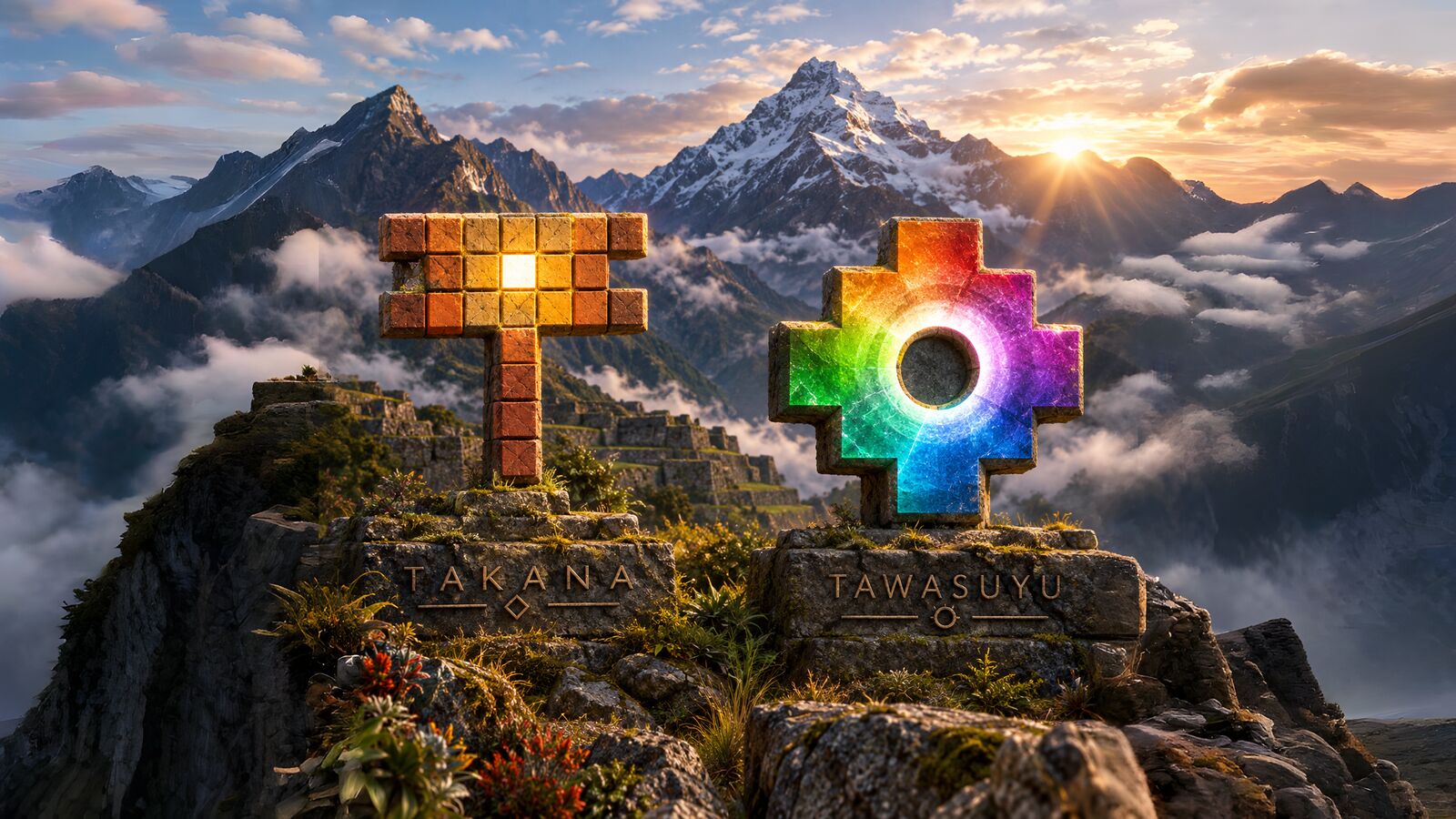
What tawasuyu is
tawasuyu is a vertical software suite written in Rust. Among its pieces there is an operating system that boots straight on the hardware, with no Linux underneath; its own graphics engine, Llimphi; a desktop with its window manager; a web browser with its own engine, without Chromium or WebKit; a writing environment where the same text lives in several languages and tones; an ERP, an astronomy engine, mail, music, video and a medical record.
The odd part isn’t the quantity. It’s that none of it rents its foundations: everything rests on the same format, the same identity and the same engine that draws, and none of them has an owner other than you.
Sovereignty, layer by layer
The word has been worn thin by speeches, so it’s worth bringing it down to something that can be checked. On an ordinary computer, every layer has an owner who isn’t the person using it. In tawasuyu, each one has a piece of its own that replaces it:
| Layer | Who usually rules | In tawasuyu |
|---|---|---|
| Booting | someone else’s kernel and system | wawa, an operating system of its own, and arje, the first process (init) |
| The pixel | Qt, GTK, Flutter or a hidden browser | Llimphi, a graphics engine that draws every button in the suite |
| The web | Chromium or WebKit, almost always | puriy, a browser with its own JavaScript engine |
| Who you are | an account a third party gives you and can take away | agora: your identity is a key you generate yourself, on your own machine |
| Your files | a central index that can be seized or censored | every file is named by its content: the name is the proof it wasn’t altered |
| The network | servers in the middle | peer-to-peer connections; the system of its own also speaks a network protocol of its own |
| The history of the code | a third-party platform | minga, a version control system of its own, and the code on the author’s own server |
| Foreign formats | the vendor’s program | 46 declared bridges —PDF, Excel, Word, Photoshop, torrent…— that read and write without getting into the core |
And the rule behind the table is a single one: what comes from outside enters through a bridge, never into the centre. A PDF opens, a spreadsheet gets imported, a website gets visited; but inside, everything works in the native format, and if tomorrow the maker of that format disappears, what is yours stays readable.
Survival doesn’t belong to the individual alone
So far, this could be the dream of someone who wants to lock themselves inside their machine. But individual sovereignty has a well-known limit: one person alone doesn’t sustain a road, a record or a decision. And that is where the project looks to the Andes.
For thousands of years, Andean peoples sustained roads that crossed a continent and terraces that still yield harvests, without money or alphabetic writing. What sustained them wasn’t a technical device but a way of organizing: ayni, exact and measurable reciprocity; minka, voluntary work for the common good; and the ayllu, the sovereign community as the unit, instead of the isolated individual.
tawasuyu translates that idea into cryptography. A file named by its content has no central index anyone can seize. An identity that is a key doesn’t need a master registry to authorize it or cancel it. And a community that decides by a signature threshold —so many of its members have to agree— doesn’t depend on who owns the server. It’s the same premise, written this time in Rust.
Four regions, one cycle
The name is the blueprint. Tawa is four in Quechua and suyu is region: tawasuyu means four regions. The whole repository is split in four, and each part corresponds to a phase of what happens to information: it is perceived, known, acted upon and sustained.
| Region | Phase | What lives there |
|---|---|---|
| 00_unanchay | Perceive | What picks up signals: the browser, notes, language, writing, news comparison. |
| 01_yachay | Know | What models and computes: astronomy, simulation, physics, the ERP, the medical record, claim verification. |
| 02_ruway | Do | What acts: the graphics engine, the desktop, the terminal, music, video, mail, games. |
| 03_ukupacha | Root | What holds everything up: the operating system, booting, identity, the network. |
Yachay is knowing and ruway is doing. Unanchay is related to the signal and to noticing it. Uku pacha is, in the Andean worldview, the inner world, the one below: the place of roots. It’s no accident that sovereignty starts there: whoever doesn’t own the root owns nothing of what grows on top of it.
And it isn’t an administrative division. Moving a program to another region changes what it is. tawasuyu has two programs that work with news: watuy harvests claims and puts them side by side, and lives in perceive; iniy (in Quechua, to believe) verifies them, and lives in know. Collecting a claim isn’t taking it as true, and the code doesn’t let the two be confused.
The chakana: everything goes through the bridge
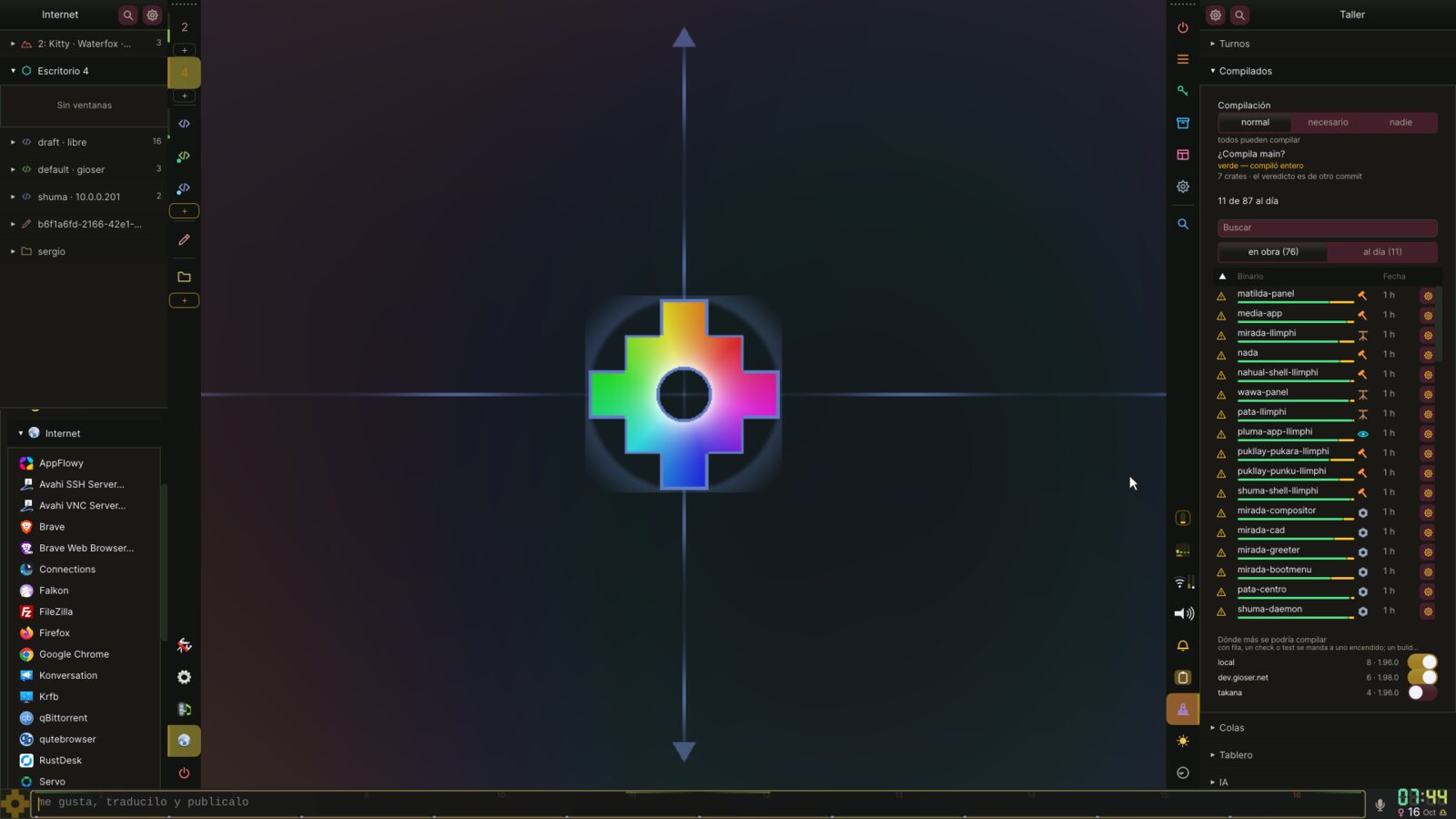
The logo is a chakana, the Andean stepped cross with a circular hole in its centre. It has been carved in stone since Chavín and Tiwanaku, and it still appears in textiles someone weaves today. Its name comes from chaka, bridge.
In tawasuyu the chakana isn’t an ornament: it’s the diagram. The four regions are its four arms, and at the centre is the bridge. The rule it draws is strict: nothing communicates by skipping ahead; everything goes through the middle. It’s the same rule as foreign formats, seen from above: whatever crosses, crosses at a declared place, where it can be looked at.
Apps woven together like an ayllu
tawasuyu’s applications aren’t conceived as standalone programs. The project’s documentation says it in one line: they are Andean institutions written as software. And almost all of them do the same thing to a different institution: they remove the middleman.
| Name | The tradition | In tawasuyu |
|---|---|---|
| ayni | reciprocity: what I give you today comes back when it’s my turn | credit among acquaintances, interest-free, with no bank or server |
| mit'a | work in shifts for the common good | attested community work turns into reciprocal credit |
| minga | everyone’s voluntary communal work | peer-to-peer collaboration and its own version control |
| tantanakuy | to gather | the assembly: call, quorum, vote and signed minutes, with no platform hosting it |
| khipu | the knotted cords that kept memory | notes that reinforce each other, or fade, kept on your own machine |
| siqi | the lines that joined each place to the centre | automations: every rule is a piece of data that can be signed |
| tampu | the storehouses along the road | a community’s shared objects |
| chasqui | the relay messenger | the one that carries data from one program to another |
And they are woven together as in an ayllu: work recorded in tampu becomes credit in ayni, the tantanakuy assembly signs its minutes as a community, and those minutes go into a public record. None of those steps needs to ask a company for permission.
Agora and the seal of the ayllu
That idea has its own place in agora, the plaza of identity. A community has its constitution and its own seal, which is only stamped when the members it set itself have signed. The person is sovereign and the community can sign as one, without anyone signing on someone else’s behalf. Agora deserves an article of its own, and it will get one.
A tribute
When the conquest banned the assemblies and persecuted the language, the Andean way of organizing was not lost: Quechua is still spoken and the stepped cross is still woven. In its own way, it is the longest proof of sovereignty there is: what a community sustains outlives whoever tried to take it away.
tawasuyu is a tribute to that architecture. It isn’t a flag: Quechua is the language of many peoples and crosses borders, and the project speaks on behalf of none of them. It learns from them. It takes the idea that resisted the longest —that what endures isn’t what an owner keeps on their server, but what a community sustains— and writes it in the place where today it’s decided who rules: software.
What isn’t there yet
- The operating system of its own doesn’t replace Linux in daily use yet. Today tawasuyu’s desktop runs on a Linux kernel and its drivers; the root of its own exists and boots, but it doesn’t carry everything yet.
- The browser of its own doesn’t open the whole web yet. Its JavaScript engine passes 13.1% of the language’s official test suite (Test262), and the browser 22.1% of the web platform subtests (WPT) already run against it. It grows every week, and the numbers are published as they come out.
- The hardware isn’t sovereign. The processor, the graphics card and their firmware still belong to whoever made them. tawasuyu starts where the silicon ends.
- The names take some getting used to. A newcomer doesn’t know what nakui or kamachiq is without reading its description, and the Quechua on some screens hasn’t been reviewed by a speaker yet. Reviews are welcome.
How to see it
The code is at git.tawasuyu.net —on a server of its own, not on someone else’s platform— and the full map, at tawasuyu.net. To check what this article says, just open the root of the repository: the four regions are the first thing you see.